

CW: What are the origins of John Hendrix?
JH: I grew up in St. Louis, Missouri, which happens to be where I live now. I've also lived for seven years in Lawrence Kansas, and spent 4 years in New York, NY.
CW: What is your educational background?
What courses or training might
be helpful in beginning a career in illustration?I studied illustration in my undergraduate experience, and though that is really great training- illustrators have often come into the field from unusual backgrounds. The program I studied in was called "Visual Communication" and that an important distinction. We must remember, as illustrators, that our primary goal is not expression, but communication. That is why learning how to use 2-D design skills like hierarchy, scale-shift, figure/field relationships are really helpful to learn about communication. We have to strive for not just interest but clarity.


CW: You're illustration career is in a way just beginning.
However you seem already very successful.
Is illustration your only means of support or
do you have a day job as well?
JH: I illustrate about 60 editorial jobs a year, along with a book about every year and a half. On top of that I do teach illustration at Washington University in St. Louis. Teaching is wonderful, despite the hassles of committee work and occasional problem studen

ts. I love talking to others about illustration and showing young artists things they have never seen before. What an honor to say to a student "You ever heard of Robert Weaver?" Then watch their eyes bug out when I show them his original Yankee Spring Training Sketchbooks in WashU's Modern Graphic History Library. And I learn nearly as much as they do, because trying to describe your process and methodology requires examination of your own work in new ways. I dont' teach for the money, as many of my students think. I could easily get by freelancing. I really do love getting out of the studio and interacting with these s

tudents and the other faculty. It keeps you young!
CW: When I first met you we worked on a project called Castaways. You illustrated the cover art. But at the time you were using a different style. How did you develop your current line art style and why did you let go of your old style?
JH: At the time we did our first project together, I was working in a very tight paintin

g style. It was something I had developed in undergraduate school. When I g ot to graduate school, I began to look around my studio and realized the work I hung up in my space that I admired looked NOTHING like the stuff I made. Slowly I realized that I loved drawing way more than painting. My sketchbooks were key to unlocking the visual voice that is much more true to who I am.
CW: What lessons do you think could be learned by this self realization?
JH: Part of the lesson is that even if you are getting work, it might not be the work you want. That is what happened to me. Ultimately I was selling somethi ng that I thought would make me successful, even though it was a product I couldn't believe in. Now, that realization comes now after years of distance. At the time, it felt crazy to turn down a book jacket illustration (that you gave me right after Castaways) because it was the kind of thing I didn't want to be doing for the next 30 years. I was still in grad school and felt that I had to right the ship while I could and take a chance to make the kinds of images I wanted, not the ones I thought others wanted m

e to make.
CW: You have done work with Sports Illustrated, Entertainmen t W eekly, Rolling Stone, The New Yorker, Esquire, The New York Times, and Nickelodeon among many others. What drew you to children's book illustration? How did your first book come to be published?
JH: Children's books were the first illustration vehicles that I truly loved. Its the aspect of fantastical storytelling that drew me to visual stories. Of course, my editorial career took off and I love doing those images as well, but my heart has always leaned towards story in sequence. My first book I wrote, John Brown, ended up being my second boo k. As I was looking for a publisher for John Brown, I found several manuscripts that people wanted me to illustrate. Given my civil war interest, the story for "Abe Lincoln Crosses a Creek" was a perfect fit.
CW: What are some of your favorite books for children?
JH: Oh boy. Where to start?
Back in college I loved
The Mysteries of Harris Burdi ck, by Chris Van Allsburg. Lizbeth Zwerger's
Wizard of Oz is up there for me as well. Recently I've really been an admirer of the zany and visually driven books of Shaun Tan and Adam Rex.
The Arrival and
Frankensteinmakes a Sandwich . But, I can leave out the haunting and truly visionary Caldecott winner from last year
The Invention of Hugo Cabret -Golly, that thing is a masterpiece.
CW: Who are your artistic influences?
JH: I love love love the following artists:
Winsor McCay, Barry Blitt, Arthur Rackham, Jack Unruh,
Kadir Nelson,
NC Wyeth, Edward Hopper, Joseph Cornell, Dean Cornwell, Robert Lawson . . . on and on!
CW: JOHN BROWN is your second children's book a nd the
first full picture book project we worked together on. Can you describe
your creative process? And how you approached the
challenges of this particular book? JH: It has been a long time coming as you know, but the process has been very rewarding. For me, all ideas start with visuals. I first fell in love with John Brown as a visual subject. When I started reading about him, I also loved who he was and what he believed in. So, I made a list of all the images I wanted to include in a story about his life, and wrote the book around those ideas. Even though I wrote this book, I would never start with words. I am not a 'writer's writer'... but an artist who uses words to frame and create my own visual content.
so long for it to become re alized as a finished book? 
JH: Yes, even though the book took five years to go from idea to publication, I wasn't working on it the whole time. I sold it to another house in 2004 and we worke d on it for a year trying to get the manuscript right. It went from being about 2500 words to 6000 and then back to 3000, but they weren't able to resolve some of the more difficult content issues I mentioned. So, it was dropped in 2005. (By the way, they were super nice and it was all very amicable in the end. No one felt worse than they did that it didn't work. But I was still crushed.) It got new life back in 2006 when Abrams took a chance on me. (cue ABBA!) Then another year in edits and sketches and six months in final art. Voila!
Now, the way I first got into selling the idea was pretty silly. I had some drawings in my book of John Brown and I went to a portfolio show where I met an assistan t art director who said "Hey, if you like John Brown, he'd be a great kids book" I laughed and laughed, then realized she wasn't kidding and said "I think you're right." I had worked o n a draft for a few weeks, then the AD called me and said "I'd love to take a look at your JB book idea." At this point, I had nothing really but faked it. "Of course, I'll bring it in next week." So, I crushed the dummy draft in about 10 days and they really loved it. What helped was that I used my design skills to design and layout the entire book as I saw it being realized. It wasn't just floating drawings and handwritten copy. I really packaged the whole thing, using the typefaces I wanted, and the hand drawn text. So, in the end, I think what the belie ved in was my ability to make a book, not so much that John Brown would be good content. But fortunately, it has a happy ending. Thank you ABRAMS!
CW: For almost as long as I have known you, you have
been working on JOHN BROWN.
Why John Brown? What is it about this
historical figure that captures your attention?
JH: To me, he is a true civil rights hero. And most people think he is a lunatic. We have this popular image of him as an insane loony who killed people w

ith some flawed notion of his own importance who was punishing innocent civilians because of his religious beliefs. When you really read what he believed and why he was brought to his actions- you see just how unique he was in his own era. A true visionary, and he has been minimized because I think most people are uncomfortable with people who are strongly motivated by religious ideas. So, as a person who shares the faith of John Brown, I feel as though he deserves a more accurate account of his life.
aspects of your work on JOHN BROWN?JH: The challenges are easy to pick out. Though I really think there is value in talking to children about the nature of human conflict and the nature of evil, showing the events of his life (visually!) to an audience of young people was tough. You don't want to sugar coat his action and create some inadvertent propaganda. But you also need to be sensitive and protect young people from things that would negatively affect their minds. Generally I think that kids are pretty robust thinkers and can handle cognitive dissonance, as long as we present it in a manner that is clear.
CW: One of the struggles I recall was making the story more 'kid friendly' without changing history too much. How did you manage throu gh this idea?JH: Yes, it is tough to hold these in tension, but neither can be neglected. One point is that you can't avoid the truth. So, in regards to the Harpers ferry attacks and the deaths in Kansas—I think you address it calmly in the text, but in the text only. Let the pictures solve the context and the text answer the specifics. I think its expected that an artist will take a certain amount of liberty in telling a story, but you don't want it to be in the part s that everyone expects you to change in order to make your point. That could really undermine my point of view abo

ut his ideas if I throw metaphorical softballs at all the toughest events from his life.
CW: One aspect of your work I love is your use of hand drawn in the design of the page.
What inspires you to work with typography?JH: I love, love, love, typography. I also studied and completed a degree in Graphic Design in undergrad and I've always been attracted to artist who use graph ic space in their work (Al Parker, Josh Cochran, for example) But, the building blocks of illustration is word and image. Without text, there is no such thing as illustration. So why not have them in the same space and interacting in the same language. Also, as an artist who is writing his own books, I feel like I have to offer something that a writer alone or illustrator alone can't provide. So, the interaction with text inside the frame is a way to create a hybrid language in my work.
CW: What is next for you?JH: Well, good news. We will be working together on another book centered on the Civil War. called
Nurse, Soldier, Spy: The Story of a Civil War Woman by Marissa Moss. A great story about a young girl, Sarah Emma Edmonds who dresses up like a man to fight for the Union. True story!
CW: Sweet. I can't wait!
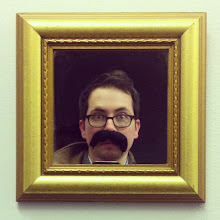
CW: Have you thought about growing a beard like John Brown? His is quite impressive!
JH: Uh, have you seen the picture of me on my website bio page???
http://johnhendrix.blogspot.com/
http://www.johnhendrix.com/
JOHN HENDRIX
ISBN: 0-8109-3798-7
Hardcover with jacket
US $18.95
Availability: Preorder (available in Summer 2009)
Interview Adventure Series • 4 •
Starring Kelly Murphy illustrator of Hush, Little Dragon coming soon!


 This new sketch compositionally was better than the last, it definitely had action. I loved how the type was developing but now John Brown appeared to be crazy pants rather than a 'hero' . How where we to make him appear to be a 'hero'. At first this was a hard thing to do. mainly because of his beard. It made him look Joaquin Phoenix / Una bomber crazy. This had to change. I suggested thinking of Superman crossed with Moses.


 For more about JOHN HENDRIX check out this cool interview.

 For more about JOHN HENDRIX check out this cool interview.




 Posts


